
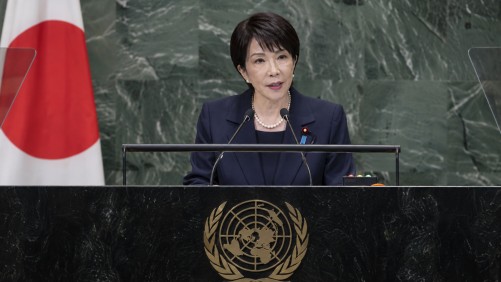
Japan’s commitment to upholding international law and supporting global stability could lead to stronger international cooperation and reform within the United Nations. Prime Minister Sanae Takaichi emphasized this during her inaugural speech to the UN General Assembly, where she underscored Japan’s dedication to the International Criminal Court (ICC) and the need for an inclusive international order.
Addressing a post-Cold War era marked by instability, Takaichi called for significant reforms in the UN and its Security Council to better reflect the diverse global community. Her advocacy for changes highlights Japan’s proactive role in fostering a more equitable international system, especially in light of ongoing geopolitical tensions.
While reaffirming Japan’s historical support for international judicial bodies since World War II, Takaichi did not comment directly on the recent US sanctions against ICC President Tomoko Akane, a fellow Japanese national. This omission may signal Japan’s cautious diplomatic navigation amid complex international relations.
The prime minister also condemned Russia’s military actions in Ukraine, labeling forceful attempts to alter the status quo as unacceptable. She urged the international community to intensify efforts against North Korea’s nuclear ambitions while expressing Japan’s readiness to engage in dialogue to resolve the issue of Japanese citizens abducted by North Korea.
In terms of economic and energy security, Takaichi outlined Japan’s plans to collaborate with Gulf nations to ensure stable energy supplies, addressing disruptions in vital trade routes. Her call for enhanced global cooperation on critical resources and artificial intelligence underscores Japan’s strategic approach to maintaining economic resilience.