
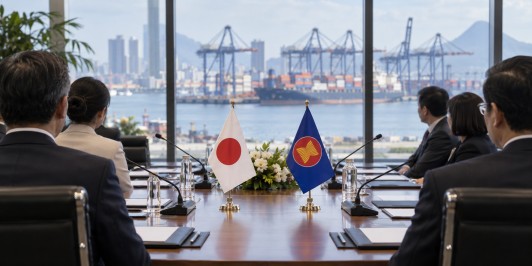
The decision by Japan and the Association of Southeast Asian Nations (ASEAN) to explore expanding their economic partnership agreement could significantly bolster supply-chain resilience, energy security, and the integration of artificial intelligence across the region. This strategic move aims to address disruptions in global supply chains and ensure stable energy supplies, amidst rising geopolitical tensions and trade uncertainties.
During a recent meeting of economic ministers in Manila on September 20, Japan and ASEAN resolved to study updates to their existing agreement, which was originally enacted in 2008. The focus is on adapting to the evolving economic landscape, where artificial intelligence is increasingly influential, and supply-chain vulnerabilities have been exposed by global events. The discussions also highlighted Japan’s commitment to supporting ASEAN countries in strengthening their oil stockpiles, a measure seen as crucial for enhancing regional energy security.
The existing Japan-ASEAN economic partnership agreement has already expanded beyond its initial scope to include trade in services and investment. In 2025, the two entities reported a robust $245.4 billion in two-way merchandise trade, with Japanese investment in ASEAN reaching $9.5 billion, underscoring the economic interdependence between Japan and the Southeast Asian region.
As both parties look to the future, the emphasis on closer economic cooperation is viewed as essential for navigating the current geopolitical climate. The potential expansion of the partnership agreement is set against the backdrop of growing risks to key supply routes, particularly in the Middle East, highlighting the need for a coordinated approach to energy security and economic collaboration.
By examining ways to modernize their agreement, Japan and ASEAN are positioning themselves to better manage the challenges and opportunities presented by technological advancements and global economic shifts. This proactive stance could pave the way for a more resilient and integrated economic partnership in the region.