
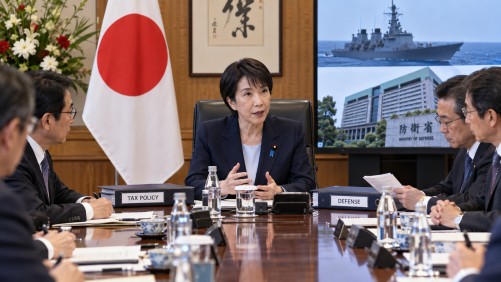
Japan’s government is gearing up to address key economic and security challenges under Prime Minister Sanae Takaichi’s newly reorganized Cabinet. As the Cabinet prepares to convene next month, the immediate focus will be on crucial legislative measures aimed at easing economic burdens on citizens, including reducing the consumption tax on food and linking cash payments to income levels.
These legislative efforts are set to be discussed during an extraordinary Diet session expected to take place in early October. However, the ruling coalition, comprising the Liberal Democratic Party and Nippon Ishin, lacks a majority in the Upper House, necessitating collaboration with opposition parties to ensure the passage of these key initiatives. Finance Minister Satsuki Katayama, retained in her role, will spearhead the push for these economic reforms.
In addition to domestic economic policies, Japan’s foreign relations and defense strategies are under scrutiny. Foreign Minister Toshimitsu Motegi and Defense Minister Shinjiro Koizumi continue in their roles as the nation navigates complex relationships with China and the United States. These diplomatic efforts are particularly critical given ongoing tensions with China, especially in relation to Taiwan’s security concerns. Takaichi is scheduled to attend the Asia-Pacific Economic Cooperation summit in Shenzhen, China, in November, a move that underscores the importance of diplomatic engagement in the region.
The Takaichi administration is also prioritizing a comprehensive update of Japan’s national security framework, with revisions to three major security documents, including the National Security Strategy, expected by year-end. These updates are crucial as Japan seeks to refine its defense policies amidst regional security challenges.
Furthermore, the government faces the daunting task of reconciling increased defense spending with fiscal responsibility. This challenge involves finding ways to fund defense enhancements without exacerbating the financial burden on the public. Concurrently, Prime Minister Takaichi has called for advances in constitutional reform, although concrete proposals have yet to gain significant traction.