
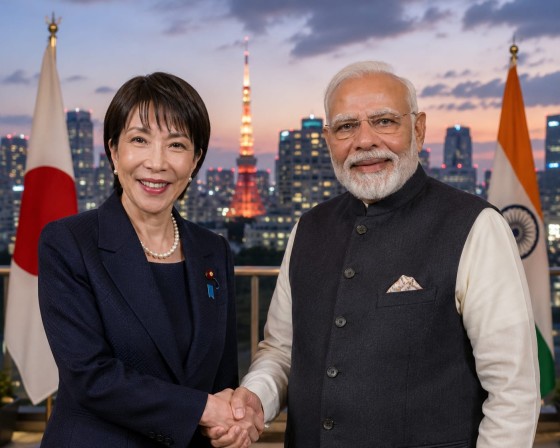
In a significant move to bolster ties, Japanese Prime Minister Sanae Takaichi and Indian Prime Minister Narendra Modi have pledged to enhance cooperation across security, economic resilience, and advanced technology sectors. The recent summit held in New Delhi saw both leaders emphasize their shared commitment to maintaining a free and rules-based Indo-Pacific region. They voiced mutual concerns regarding economic coercion and regional developments in the East China Sea and South China Sea.
The two nations are set to fortify their supply chains, focusing on strategic areas such as semiconductors and critical minerals. This initiative comes amid heightened global interest in securing essential resources and technologies. The commitment extends to the defense sector, with plans to amplify joint military exercises and improve collaboration in naval vessel maintenance and defense equipment development. Additionally, a “two-plus-two” meeting, involving foreign and defense ministers from both countries, is scheduled for later in the year to further these discussions.
On the economic front, substantial progress was made as Japanese and Indian companies signed 129 memorandums of understanding. These agreements represent investments nearing ¥2 trillion ($12.4 billion) and span sectors critical to the future, including semiconductors, artificial intelligence, automotive manufacturing, and advanced technologies. Such collaborations underline the robust economic partnership and the shared vision of technological advancement between Japan and India.
Another key area of focus is the advancement of artificial intelligence, where both countries have agreed to intensify their cooperative efforts. A notable goal set during the summit is the integration of 500 Indian AI specialists into Japan’s research landscape by 2030. This initiative aims to foster joint research and innovation, reinforcing the growing collaboration in emerging technologies that are set to shape future industries.